This work is dedicated in Loving Memory to Andrew Hunter, who held my (virtual) hand through this process, encouraged me and provided an abundance of information and material.
a conference in conjunction with Kampnagel International Summer Festival, Hamburg, in collaboration with Missy Magazine
“Beyond the moral and political questions of how to handle sex work, it has also become very clear that the debate is dominated by projections, fantasies and myths.”
Whore Images: Bleeding Hearts and Critical Thinking[1]
by Carol Leigh
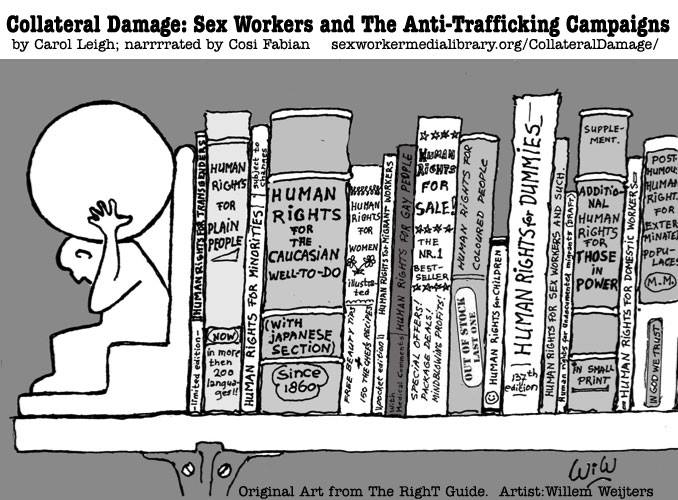
I am honored to screen Collateral Damage: Sex Workers and the Anti-Trafficking Campaigns at Kampnagel’s sex work issues conference “FANTASIES THAT MATTER. IMAGES OF SEXWORK IN MEDIA AND ART.” The images of trafficking play a particularly crucial role in this crusade. The images
Pye Jakobsson, a dedicated activist fighting for the human rights of marginalised groups, discusses the advantages of the sex workers’ rights and anti-sex trafficking movements working together.
Pye Jakobsson is a former sex worker, presently taking a break from sex work while working in HIV-prevention. Her current roles include Project Manager at Hiv-Sverige/HIV-Sweden, Co-Founder and Coordinator at Rose Alliance, an NGO by and for current and former sex and erotic workers in Sweden, and President of The Global Network of Sex Work Projects (NSWP), which advocates for rights based health and social services, freedom from abuse and discrimination, and self determination for sex workers.
Could you share how you became involved in the sex workers’ rights movement and why it’s so important to you?
I actually started out in the HIV-rights movement in Portugal in the ’80s. When I moved back to Sweden in 1994 I was quite shocked at the judgmental and infantilizing attitudes there was against sex workers and just started doing activism on my own. I was quite naïve I guess as it was sort of…
Some 560 NGOs and civil society organisations along with 86 academics and researchers urged the European Parliament to reject the report promoting the criminalisation of the purchase of sex that was put forward by London MEP Mary Honeyball in a plenary session this week in Strasbourg. But although the European Parliament has voted in favour of the report, putting pressure on EU member states to re-evaluate their prostitution laws, they do not need to make the same mistake.
In sound bites, the Swedish Government has been spinning their sex purchase ban, known as the “Swedish model” or sometimes the “Nordic model” though it is not adopted by all Nordic countries, as a success. However, research does not show it has reduced sex trafficking or sex work. In addition, their own police report demonstrates it has pushed prostitution indoors with nearly three times as many Thai massage parlours in Stockholm and the vicinity:
Mary Honeyball, Labour’s Spokesperson on the European Parliament’s Women’s Rights and Gender Equality Committee, who wrote the report recommending the Swedish sex purchase ban, said she wanted a model that reduced prostitution. She claims demand has halved in Sweden. However, this is untrue:
On Sunday 23 February, I met Mary Honeyball at the BBC1 debate on The Big Questions about whether it should be illegal to pay for sex. Clearly, by the inaccuracies she was stating, she is misinformed – and misinforming others – about the actual outcomes of the Swedish model.
There is very little evidence to suggest that any criminal laws related to sex work stop demand for sex or reduce the number of sex workers. Rather, all of them create an environment of fear and marginalisation for sex workers, who often have to work in remote and unsafe locations to avoid arrest of themselves or their clients. These laws can undermine sex workers’ ability to work together to identify potentially violent clients and their capacity to demand condom use of clients. (UNAIDS Guidance Note on HIV and Sex Work)
As someone who had a traumatic experience of prostitution, mine is a standard narrative held up as an example of why the Swedish model is needed. But actually my traumatic experience in the sex trade, suffering being raped more than once and beaten once, every time while working alone, and ending up an intravenous heroin and crack addict, is a prime example of why decriminalisation is needed.
There is no drug harm reduction practised in Sweden because it is deemed to enable drug use. So as a former intravenous addict, I would probably have died from a blood-borne virus or perhaps lost a limb. Equally, there is no harm reduction for sex workers because access to free condoms is erroneously believed to encourage people to sell sex. So I would be at an increased risk of HIV and other sexually transmitted diseases if I was unable to afford my own condoms. These issues primarily affect women working on-street who are most often in poverty and many suffering with addiction. The sex purchase ban has put these women in more danger:
The approach of criminalising the client has been shown to backfire on sex workers. In Sweden, sex workers who were unable to work indoors were left on the street with the most dangerous clients and little choice but to accept them. Where sex work is criminalised, sex workers are very vulnerable to abuse and extortion by police, in detention facilities and elsewhere. (UNAIDS Guidance Note on HIV and Sex Work)
The Swedish model has meant for sex workers who are mothers, they are at risk of losing custody of their children as by selling sex they are deemed unfit parents. This happened to Petite Jasmine and custody of her children was given to the father, a man known to be violent, who had threatened and stalked her. She was given no protection by the Swedish authorities. Then, in 2013, he murdered her.
The Swedish model is social cleansing, something Sweden has history of undertaking. It must not be done in this country or in any country.
Without the criminalisation of the purchase of sex the UK, and other countries, should work to establish comprehensive services to meet the needs of women, men, trans men and women, and nonbinary people seeking to leave the sex trade. There are 80,000 people in prostitution in the UK, most of whom are in poverty and 70% are single mothers. Huge investment from the government is needed and these complex services are going to take a long time to build. Additionally, these services will not work if they are forced.
For many women selling sex, they do not have other options, so we need to reform our benefits system and end poverty so no woman has to sell sex in order to pay her rent so her family are not made homeless, to ensure her children eat, or to heat her home. Criminalising her clients is not going to help her. It will only put her in greater danger.
The priority for police must be building trusting relationships with people in prostitution as it is in Merseyside, but this is impossible when clients are criminalised under the Swedish model. Merseyside has astonishingly high conviction rates for violent offenders targeting sex workers, which makes all of society safer. Their hate crime model, working closely with sex work projects that offer harm reduction services, has great results on assisting women leave the sex trade and ‘exiting’ is not the focus.
Women being able to work together in well-lit areas on-street and a small number of women being able to work from premises together should be decriminalised as research shows whether on-street or off-street, women are more at risk of rape and other violence when they are on their own and isolated. The two women who were recently murdered in London were working alone: Mariana Popa who was working on-street, and in an area where a police crackdown on street prostitution was being enforced, and Maria Duque-Tunjano who was working alone in a flat. Under decriminalisation they might still be alive because they would have been able to work with other women for safety.
Decriminalisation also means sex trafficking victims do not need to fear arrest and being charged. Jes Richardson, a sex trafficking survivor, was not able to turn to police for this reason, and it was a sex worker who helped her escape. She is another woman formerly in the sex trade who is advocating for decriminalisation. The Swedish model, according to the Swedish Police report, cannot demonstrate it has reduced sex trafficking:
According to the Swedish National Police Board it is difficult to estimate how many people may have fallen victim to human trafficking in Sweden during 2011. The number of victims discovered in Sweden depends largely on the resources which the police put into detecting this crime and on the skills that exists within the police organisation. The level of these initiatives varies between police authorities and differs from one year to another. Neither is it possible to identify (nor indeed to locate) all of the victims, mostly girls and women, who are mentioned in tapped telephone calls or observed during police surveillance. (The Swedish National Police Board, Situation Report 13 “Trafficking in human beings for sexual and other purposes” for the year 2011)
Sex workers are often well placed to identify and assist sex trafficking victims and essential in ensuring this and developing it further are good relationships between the police and sex workers.
Dr Jay Levy, who conducted research in Sweden over several years on the outcomes of the criminalisation of the purchase of sex, met with me in London at the end of 2013 to discuss his findings.




 Soul Destruction