This work is dedicated in Loving Memory to Andrew Hunter, who held my (virtual) hand through this process, encouraged me and provided an abundance of information and material.
a conference in conjunction with Kampnagel International Summer Festival, Hamburg, in collaboration with Missy Magazine
“Beyond the moral and political questions of how to handle sex work, it has also become very clear that the debate is dominated by projections, fantasies and myths.”
Whore Images: Bleeding Hearts and Critical Thinking[1]
by Carol Leigh
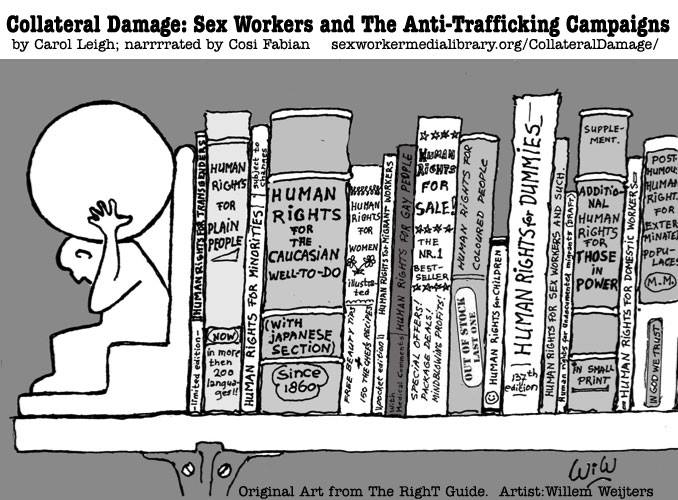
I am honored to screen Collateral Damage: Sex Workers and the Anti-Trafficking Campaigns at Kampnagel’s sex work issues conference “FANTASIES THAT MATTER. IMAGES OF SEXWORK IN MEDIA AND ART.” The images of trafficking play a particularly crucial role in this crusade. The images
Most people are voiceless because no one is letting them talk or listening to them when they do. There is a lot to be said for quitting being the voice of the voiceless and letting people speak for themselves. But not by those seeking to abolish the sex trade. Words are put into people’s mouths when they can be, and when they can’t, those people are silenced and dismissed.
Amnesty International UK has not accepted such tactics, instead listening to people in the sex industry and voting for decriminalising the consensual sale of sex between adults and rejecting the “end demand” Swedish model at their recent AGM. But in the European Parliament, these underhand tactics, which influenced voting earlier this year, have yet to be condemned.
These are 5 places where lies and silencing tactics need to stop:
1. Fundraising – dishonest activists and making children lie
At the end of May, Somaly Mam, a celebrity anti-sex trafficking activist and fundraiser, resigned from her foundation, following the uncovering of lies in her own story of being sex trafficked and the discovery that she forced children to lie about being sex trafficking victims to raise funds. From the 1990s, young girls including Long Pros and Meas Ratha were made by Mam to tell harrowing stories of being sex trafficked in television interviews. Worryingly, this incident of children being forced to lie to raise funds for an NGO is not an isolated case.
2. UK & European Parliaments – bias and libel
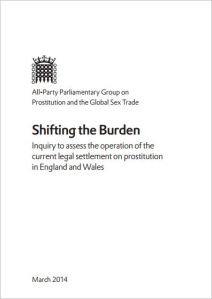
In March, the biased All-Party Parliamentary Group on Prostitution and the Global Sex Trade – funded by anti-gay charity CARE – released their biased report attributing quotes to the English Collective of Prostitutes (ECP) that were in fact said by an NHS Outreach Project Worker and using some of the ECP’s, Professor Phil Hubbard’s and my quotes out of context. The report recommends the “end demand” Swedish model, which does not work to end demand, but does increase danger and stigma.
In February, before the European Parliament voted on MEP Mary Honeyball’s report recommending the Swedish model, Ms Honeyball sent an email to MEPs libelling the 560 NGOs opposing her report as being “comprised of pimps”. The NGOs included anti-human trafficking, women’s rights, HIV/AIDS and human rights organisations, as well as sex worker led organisations – the people she was silencing claiming to care for. A counter-report demonstrating the severe lack of evidence in Ms Honeyball’s report was also signed by 94 academics. The Swedish law does not work and is dangerous. Sex workers deserve a law that ensures their human rights as do sex trafficking victims, not a law that fails them. Mary Honeyball’s defamation of 560 NGOs should make the result of the vote void.
3. Campaigning – ignored and spoken for
The European Women’s Lobby, Equality Now and other groups seeking to “end demand” ignore the danger the Swedish model creates. They selectively choose people formerly in the sex trade who support their approach while dismissing the concerns voiced by sex workers and their call for decriminalisation, which is echoed by the World Health Organization, UN Women, the UN Special Rapporteur on the Right to Health, the Global Commission on HIV and the Law, and Human Rights Watch among other organisations.
Lori Adorable, a sex worker who I recently interviewed on sex workers’ rights and how negative experiences of the sex trade, like mine, are often used by those seeking to abolish prostitution to argue for the Swedish model, recommends “people explore the websites of the organizations who are members of the Global Network of Sex Work Projects.” Regularly, these people are spoken for “but these women are speaking for themselves, and they’re asking for decriminalisation.”
4. Television – being “unrepresentative” and spoken over
Women currently and formerly in prostitution are used in a tokenising way by anti-prostitution feminists and religious fundamentalists pushing for the Swedish law that will result in dire consequences on lives they cannot even imagine living. When we do not satisfy the requirements of their mouthpiece, we are discounted, shut up and shut down.
Laura Lee, whose experience of sex work is positive and very different to my own, is discounted and told she is not representative on BBC Newsnight.
On BBC1 The Big Questions, I am spoken over by a woman claiming to care for women like me, who have had a traumatic experience in prostitution. Though earlier in the programme, she says I make prostitution sound “warm and cuddly”. For those who know me, they will know how ludicrous this is.
5. Social media – the pimp lobby, dismissing and co-option
Current and former sex workers who disagree with the “end demand” agenda are told they are not representative, they are pimps, they are shills of the sex trade lobby, they are suffering from false-consciousness, and some have received threats of rape and death.
I am accused of being the “Pro-Prostitution-Lobby’s humane face” who “peddles” misinformation and fights “dirty”…by a former friend. And I am “probably very unhappy”, but then she would know through the hours we spent talking on the phone (which, due to being in different countries, cost me hundreds of pounds I do not have currently).
“Before I spoke English and could use Twitter I was representative of some young Indian sex workers,” writes Molli Desi, a London based sex worker. “[N]ow I have broken through that technological and cultural glass ceiling I am no longer representative and I can be ignored.” She rightly states that this is “a disingenuous argument and disqualifies our attempts to participate. It also allows for the unheard voices of my still “representative” friends to be appropriated and spoken for by others.”
@MeghanEMurphy#twitterfeminism where were you when we had to suck police dick to escape the rescue centre that WW Fems commended ?
Women, men, trans men and women, and nonbinary people in the sex trade are not only and not always someone’s daughter, son, sister, brother, mother or father, but they are always people deserving of their right to be listened to and truly heard.
With politicians’ infamy for ‘shifting the burden’, this was not the best title for an All-Party Parliamentary Group (APPG) report. Chosen to reflect their recommendation of shifting the burden of criminalisation from the seller of sex to the buyer, in practice this fails as badly as when politicians endeavour a cover up – like why was this group funded by a religious anti-gay charity!?
Just like our politicians here, even in the face of evidence, Sweden remains adamant not to admit their mistake. Their National Police Board reports nearly 3 times as many Thai massage parlours (which are known to operate as brothels) in Stockholm and vicinity from 2009-2011/12 (from 90 to 250) but still they claim their sex purchase ban is a success. By the way, for anyone who is not aware of this, the aim of the sex purchase ban is not to increase prostitution or to push it indoors; the aim is to end sex work and sex trafficking. There is no proof of any decrease in either. And worse, there is an increase in danger, most especially for women working on-street.
As I have stated previously, without the criminalisation of clients, the government here should still invest in exiting routes for people seeking to leave the sex trade. Investment for such services is recommended in this report. However, whether or not the government will invest remains to be seen and these services will only work if they are non-judgemental, non-religious and not enforced.
It is extremely disappointing the report suggests anti-social behaviour orders for women working on-street. Is it really anti-social when a woman is doing what she can to make sure her children eat, her house is warm, her rent is paid? Because that is the reality for most women in prostitution. Most of the 80,000 people in prostitution in the UK are in poverty, and 70% are single mothers.
The APPG seems to have no idea of the effect of criminalising clients when stating people selling sex will be decriminalised. By criminalising the buyer, the person selling sex becomes the protector of their potential clients. Those working on-street have to place themselves in more out of the way and dangerous areas so the buyer is not caught. And so he is not caught, she doesn’t have time to negotiate before getting into his car, check there’s no one else hiding in the back of the car, or by talking with him seeing if he is slurring his words indicating he might be drunk. There are many dangers to this. I have been driven to the middle of nowhere and raped and didn’t expect to get out alive, and in the UK where police crackdowns on street prostitution have been instigated they have resulted in murder.
At the time of providing my written evidence last year to the APPG, I was a supporter of the Swedish model as I did believe it was in the best interests of people in the sex trade. It seemed to make sense that women, men, trans men and women and non-binary people selling sex would be decriminalised and exiting routes would be invested in and established. Clients would be criminalised to ensure a reduction in demand for sexual services, and with statistics that I had read of 9 out of 10 people in prostitution wanting to leave the sex trade if they could, the model sounded like an ideal solution.
However, the “end demand” model has failed in Sweden, a wealthy country with a small population and a small number of people engaged in selling sex. If it cannot work there, it has no chance of working in the UK.
The decriminalisation of people selling sex is a misnomer as other laws are used against them: migrants face being deported and potentially returned to dangerous countries, landlords are forced to evict if they are informed a sex worker resides in their premises and mothers face losing custody of their children purely because by selling sex they are deemed unfit parents. These issues mean when a sex worker is the victim of crime, they cannot report to police.
By the time I gave my verbal evidence, I had begun to have doubts about the Swedish model. However, I was unaware of so many issues: that it has failed to achieve its aims of reducing sex trafficking and sex work and that it creates danger and increases stigma. But my fear at the time was that exiting routes would not magically appear overnight. With 80,000 people in prostitution in the UK, who are mostly in poverty and 70% of those single mothers, where would the money come from to invest in such services, which must be complex, as well as lifting them out of poverty? So although I did not recommend the criminalisation of clients, I did not know all the facts I do now, so my reason is not the reason I would have today nor did I have the conviction I do now to fight the Swedish model.
Without that knowledge, on the day of my verbal evidence I could not report the dangers let alone the failure of the Swedish model. Though I was grateful to have the opportunity to speak at the meeting launching the ‘Shifting the Burden’ report last month where I covered nearly every point from my article condemning the European Parliament’s vote in favour of Mary Honeyball’s report recommending the criminalisation of the purchase of sex.
I believe the Swedish model is social cleansing of the poorest and most vulnerable women. This is something Sweden has a history of undertaking – forced sterilisations were taking place up until quite recently.
Women in the sex trade who are injecting drug users are the worst hit by their sex purchase ban. No harm reduction (condoms, lubrication etc.) for sex workers or drug users (needle exchanges) is provided in Sweden as it is erroneously believed to encourage sex work and drug use. That was me, an intravenous drug user who sold sex, and I am the same person I was back then and I am the same as other women selling sex and shooting up their drugs, and I will fight for those women. They matter to me, and they should matter to every person who cares about human rights and every person who claims they want to end violence against women. And if you don’t care about the women in the sex trade like me who shoot up drugs, if you care at all about human rights and are against violence against women, then you should be against the Swedish model, which is violence against women.




 Soul Destruction